JLR raids BYD offices over copycat Defender
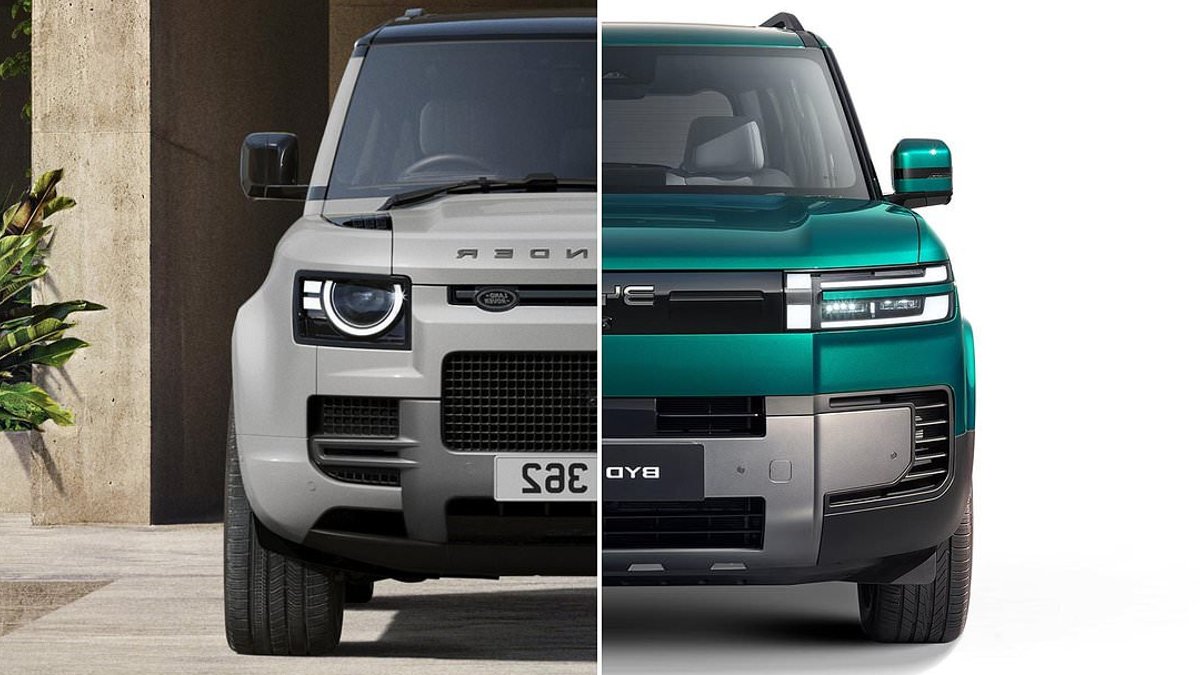
Britain’s biggest car maker, Jaguar Land Rover, has orchestrated a raid on the European offices of Chinese automotive giant BYD over accusations that its latest model is a copycat of its best-selling Defender SUV. Bailiffs seized digital documents from BYD’s Schiedam and Hoofddorp offices in the Netherlands in August, according to the Sunday Times, as JLR looks to build its case against the Chinese brand’s Ti7, which is due to hit UK showrooms early next year.
BYD alone has sold almost 75,000 cars to Britons this year—roughly one in every 25 new vehicles registered during the first ten months of 2026.
The Ti7 combines a plug-in hybrid powertrain featuring a 1.5-litre turbocharged four-cylinder petrol engine paired with dual electric motors, one on each axle, and a 35.6 kWh lithium-iron-phosphate battery. In full-electric mode, BYD says the SUV can cover about 102 miles, and it accelerates from 0 to 62 mph in 4.8 seconds.
Past Legal Actions Over Cloning
It is not the first time JLR has launched legal action over alleged cloning. In 2020 the luxury SUV maker failed in its attempt to trademark the shape of the original Defender to block Sir Jim Ratcliffe’s ‘spiritual successor’ 4×4, the Ineos Grenadier. A year earlier, however, it won a landmark case in China after a Beijing court ruled that the Landwind X7 had copied five unique features of the Range Rover Evoque.
A spokesman for JLR said the company “does not comment on ongoing legal proceedings”, while a BYD representative has also refused to comment on the matter.
Measuring 5,146 mm in length, 1,995 mm in width and 1,865 mm in height, the Ti7’s dimensions place it between the five-seat Defender 110 and the seven-seat Defender 130. BYD’s marketing emphasises the model’s “unapologetically boxy” profile, describing it as both imposing and contemporary.
Related Post: Right wing gains momentum in Europe
Chinese Brands Growing Impact in UK
Chinese brands are making a growing impact on the UK market: more than one in five (21.6%) new cars registered in October were Chinese models, and UK motorists have already ordered almost 338,000 vehicles from Chinese brands since the beginning of the year, accounting for 18% of all registrations so far in 2026.
One of the best-selling Chinese models is the Jaecoo 7, now widely dubbed the “Temu Range Rover” due to its resemblance to the Range Rover Velar, with sales of almost 43,000 units this year.
JLR Partnership With Chery Group
JLR has not pursued legal action against Jaecoo, largely because of a decade-long partnership with Jaecoo’s parent company, Chery Group. In 2012 the two firms struck a deal to build a research-and-development centre and engine-production facility in China as part of a licensing agreement to manufacture JLR vehicles and develop new models. Their most recent collaboration, announced in June 2024, sees JLR licensing its Freelander brand to Chery for an all-electric vehicle range based on Chery’s platform. The Freelander 8, unveiled earlier this year, will be sold in Chery’s UK dealerships from next year under the JLR nameplate.
Speaking at a round-table interview with journalists, Chery chairman Yin Tongyue said: “In the future, I really want to have products designed in the UK, engineered in the UK and produced in the UK to sell worldwide.”
Chery is expanding its UK presence, with plans to open a new R&D centre at the Millbrook proving grounds in Bedfordshire and a nationwide “Super Parts Hub” network of eight regional distribution centres to support Jaecoo and Omoda owners.
The company also signed a Memorandum of Understanding with Nissan this year that could see Chery manufacture up to 300,000 vehicles annually at the Sunderland plant, nearly half of the site’s 600,000-unit capacity. Meanwhile, BYD’s luxury subsidiary Yangwang has unveiled a limousine resembling the Rolls-Royce Phantom but priced at approximately half the cost.


